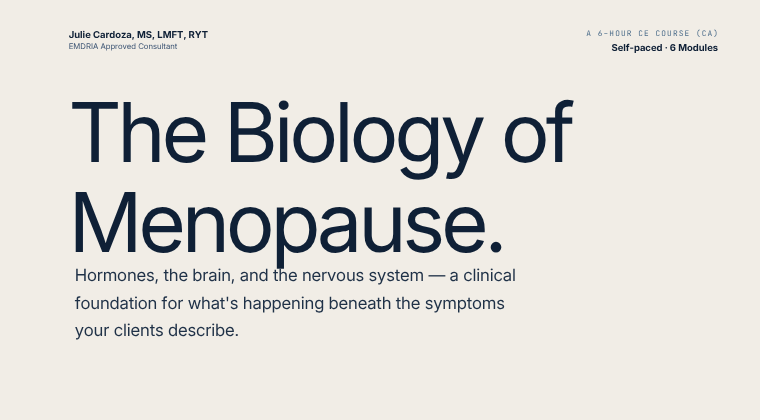
Understand the Biology Behind the Symptoms
Connect hormonal and neuropsychological changes to the mood, sleep, and cognitive presentations you're already seeing in your clients.
.png)
Apply Trauma-Informed Clinical Reasoning
Explore the ACEs–menopause intersection and learn to recognize when a client's history is amplifying what looks like a midlife mood disorder.
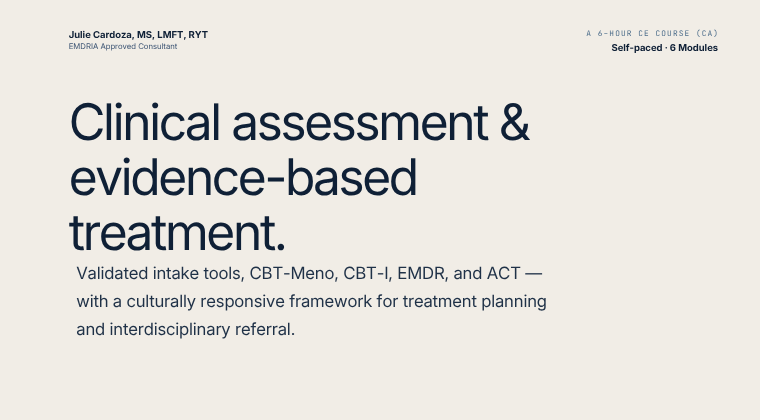
Build Evidence-Based Treatment Plans
Select from CBT-Meno, CBT-I, EMDR, and ACT interventions and design culturally responsive treatment plans for perimenopausal and menopausal clients.
Six modules, one framework
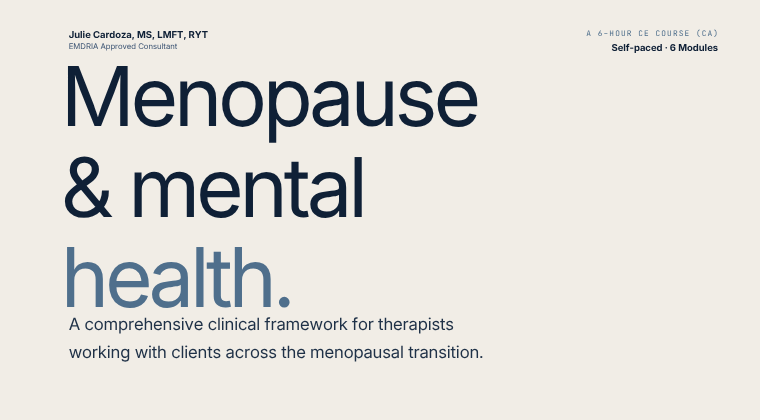
A 6-hour self-paced CE course for LMFTs, LCSWs, LPCCs, and LEPs. Each module pairs clinical content with case vignettes drawn from twenty-plus years of practice. Module 01 · The Biology of the Menopause Transition The hormonal, neurological, and physiological shifts that drive the symptoms you're seeing — what's happening in the brain and body, and why it matters for mental health work. Module 02 · Depression and Anxiety How perimenopausal mood and anxiety presentations differ from primary mood disorders, the risk factors that increase vulnerability during the transition, and what the evidence base says about treatment. Module 03 · ACEs, Trauma, and PTSD The dose-response relationship between Adverse Childhood Experiences and menopausal symptom burden, and what re-emergent trauma looks like clinically during this window. Module 04 · Special Populations Cancer-induced menopause, Primary Ovarian Insufficiency, and the clinical needs of neurodivergent clients navigating non-typical menopausal trajectories. Module 05 · Culturally Responsive and LGBTQ+-Affirming Care How racial, ethnic, cultural, and gender identity shape the menopause experience, and what identity-affirming care looks like across diverse populations. Module 06 · Clinical Assessment and Evidence-Based Treatment Validated assessment measures, evidence-based interventions, and integrated treatment planning that accounts for the full clinical picture.
.jpg)
Course Details
Format · Self-Study / Distance Learning — video, audio, reading materials, and case vignettes CE Hours · 6.0 hours of continuing education credit (1 CE credit = 1 hour of instructional time; breaks and orientation lessons are not counted toward CE credit) Tuition · $119 — all course materials, post-test, evaluation, and certificate included; no additional fees Schedule · Self-paced; available immediately upon enrollment Target Audience · LMFTs, LCSWs, LPCCs, and LEPs Level · Intermediate (2+ years post-master's experience) Post-Test · 70% minimum passing score; unlimited attempts Certificate · Auto-issued through Thinkific upon post-test passage and evaluation submission Note · Module 00 (course orientation, syllabus review, and learning objectives) is proviided as enrollment context and is not counted toward the 6 CE instructional hours. Continuing education credit Course meets the qualifications for 6 hours of continuing education credit for LMFTs, LCSWs, LPCCs, and/or LEPs as required by the California Board of Behavioral Sciences. Julie Cardoza, LMFT, CAMFT Continuing Education Provider #61115, is approved by the California Association of Marriage and Family Therapists to sponsor continuing education for LMFTs, LCSWs, LPCCs, and LEPs. Julie Cardoza, LMFT, CAMFT Continuing Education Provider #61115 maintains responsibility for this program/course and its content.

About the Instructor
Julie Cardoza, MS, LMFT, RYT, is a California-licensed Marriage and Family Therapist with twenty-plus years of clinical experience. She is an EMDRIA Approved Consultant and holds the Menopause Certificate from the Integrative Women's Health Institute (IWHI). Her clinical specialization sits at the intersection of trauma-informed care, somatic EMDR, and women's mental health across the menopausal transition. This course was developed out of her clinical practice, consultation work, and the gap she repeatedly observed: licensed clinicians treating midlife women without training in the biological, psychological, and trauma-informed dimensions of the menopausal transition. Julie Cardoza, LMFT · CAMFT Continuing Education Provider #61115 · juliecardoza.com
Learning Objectives
Upon completion of this course, participants will be able to:
Identify the stages of the menopause transition and describe the key hormonal and neuropsychological changes — including the roles of estrogen and progesterone in mood regulation, sleep architecture, and cognitive function — that affect the mental health of perimenopausal and menopausal clients.
Distinguish menopause-related depression and anxiety presentations from primary mood disorders using evidence-based clinical reasoning, and identify at least three risk factors that increase vulnerability to depression and anxiety during the menopause transition.
Describe the relationship between Adverse Childhood Experiences (ACEs) and menopausal symptom burden, including the dose-response relationship between ACE history and symptom severity, and apply ACE-informed clinical reasoning to a written case scenario.
Identify the clinical presentations and psychological needs of at least three special populations navigating non-typical menopausal trajectories — including clients with cancer-induced menopause, Primary Ovarian Insufficiency (POI), and neurodivergent clients — and describe at least one clinical adaptation appropriate for each population.
Apply at least two principles of culturally responsive and identity-affirming care to a clinical scenario involving a client whose racial, ethnic, cultural, or gender identity shapes their menopause experience, including LGBTQ+ clients.
Describe at least two evidence-based treatment interventions for menopause-related mental health concerns and design a treatment plan that is culturally responsive and incorporates these interventions for a midlife client.
Policies
Refund and cancellation. A full refund is available within 3 days of purchase if no course modules have been accessed. Once any module has been opened in the learning management system, no refund is available. To request a refund, email [email protected] within 3 days of the purchase date. Refunds will be processed within 10 business days. Course access and completion. Course access is granted for one year from the date of enrollment. Participants must complete all course requirements — including module content, the post-test, and the course evaluation — within one year of purchase to receive CE credit. Certificates cannot be issued for incomplete enrollments after access expires. Accommodations. For special-needs accommodations — including assistive technology, alternative formats, or other adjustments — email [email protected] at least 7 days before enrollment. We will work with you to ensure the course is accessible. Grievances. Grievances may be submitted by email to [email protected]. Grievances will be acknowledged within 2 business days and resolved within 30 days. A record of all grievances and resolutions is maintained.
Ready to Transform Your Practice?
Enroll now and gain the expertise to support menopausal clients effectively.
$119.00